


Mills are used for grinding. There are many types of mills. The most commonly used are ball mills, rod mills and autogenous mills. They are named according to their operating principles: metal balls are used to grind ore in ball mills, metal rods in rod mills, and larger pieces of ore grind each other in autogenous mills.
Important in the grinding process, regardless of the type of the mill, is the speed at which the mill rotates. If the ore stays in the outer perimeter while the mill is rotating, the mill’s rotation is above critical speed. For grinding to be efficient, the mill usually needs to rotate below critical speed for the material to drop and crush the ore underneath it.
Grinding can take place either in a so-called open circuit or in a closed circuit. In an open circuit, the ground material moves directly to the next stage of the process. In a closed circuit, the ground material passes through a classifier. In the classifier, the particles that are still too coarse are returned to the grinding.
The most expensive parts of rod and ball mills are the grinders. In autogenous mills, the most costly thing is replacing the lining.
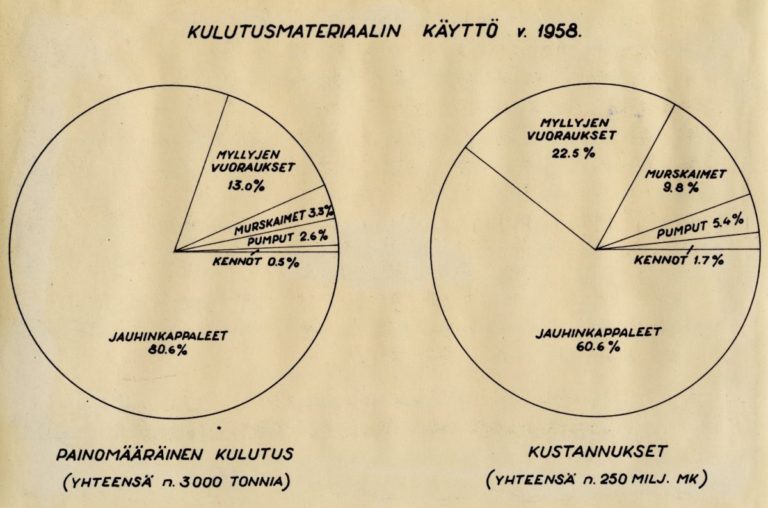
Photo: the use of wear materials in 1958. Thirty-one different mills or mills located in different facilities have been used in the analysis.
There have been mainly closed circuits in Outokumpu’s concentration plants. At the beginning of industrial concentration in 1928, however, so-called primary grinding was carried out in an open circuit. The unclassified material went from the primary grinding to tabling. Some parts of the material then continued to the secondary grinding, carried out in a closed circuit.
Jauhinmylly by digivayla on Sketchfab