


Flotation is a method applied after ore extraction and grinding to separate valuable minerals from other minerals. In flotation, chemicals cause certain minerals to attach to air bubbles created in the sludge and rise to the surface (concentrate), while the remaining minerals do not (waste rock). For example, when the pH of the sludge is above 10, copper pyrite granules are attached to air bubbles using a xanthate chemical and rise to the surface of the sludge. In flotation, all those minerals with a naturally hydrophobic surface or that can be made water-repellent or hydrophobic can be separated. Correspondingly, the surfaces of other (undesired) minerals must be hydrophilic.
The removal of a concentrate from a flotation cell can be enhanced by rotating mechanical blades. The concentrate flows over the lower edge of the cell.
Before the ore sludge enters the concentration phase, it should be fine enough (less than 0.1 mm) so that most of the different minerals (copper ore, zinc flint and sulfur ore) are separated from each other. If the sludge is too coarse, the mixed granules remain in the sludge and copper is wasted. If the sludge is too fine, the sludge will cover the copper pyrite granules, preventing effective foaming.
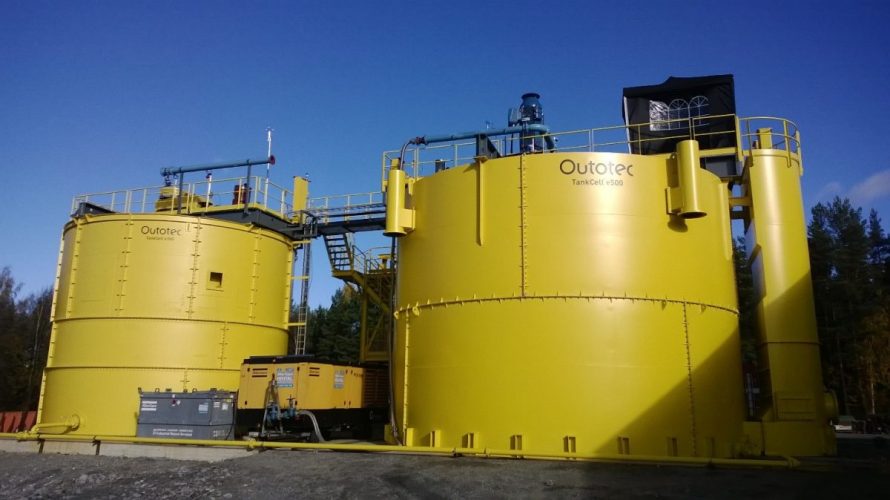
Currently, flotation uses round cells of up to 500 cubic meters (pictured on the left a flotation cell of 300 cubic meters and on the right a flotation cell of 500 cubic meters).
In the early 1950s, flotation cells of the same type as those at the old concentrating plant, were installed at the Keretti concentrating plant as at the old concentrating plant. In the 1960s, these cells were replaced with newer models. The pre-flotation of copper took place in five long rows of cells. The obtained concentrate was re-floated several times to have a sufficiently high concentration of copper concentrate (24% copper).
Vaahdotuskenno by digivayla on Sketchfab